The 1 January 2026 amendments to FRS 102 bring new requirements to accounting standards in the UK. Businesses will now have to calculate balance sheet adjustments, gather lease date, and assess the impact of revenue recognition. What’s surprising is that for many companies, work is still under progress. For some, it has not started.
Being in either position is not ideal. Companies navigating this most smoothly are the ones that treated the FRC’s revised FRS 102 as a finance project, not an accounting exercise. The idea was to start early.
For those still working through the implications or reviewing their preparation against what the financial reporting standard actually requires, have their work cut out. This guide covers the ground that matters most: what has changed, where the technical complexity concentrates, and what still needs to happen before the 2026 year-end.
What Changed and Why
The revised FRS 102 is in its triennial review, with the revised standard published in 2024. The direction of the rules was deliberate. Bring UK GAAP closer to IFRS 15 on revenue and IFRS 16 on leases, while keeping the proportionality and simplicity that make FRS 102 workable. This was true especially for UK entities that were not IFRS reporters.
| Item | Amount |
|---|---|
| Right-of-use asset | £950,000 |
| Lease liability | £980,000 |
| Annual depreciation | £190,000 |
| Annual interest expense | £58,000 |
The result is not a cosmetic update. Revenue recognition is now governed by a five-step model that changes the timing and pattern of recognition for contracts with multiple elements, variable consideration, or performance obligations satisfied over time.
Most operating leases will now be recognised on the balance sheet through right-of-use assets and lease liabilities, subject to short-term and low-value exemptions. Right-of-use assets, lease liabilities, a front-loaded cost profile replacing the straight-line operating lease expense. Neither change is confined to disclosure.
Who Needs to Pay Attention
Any UK company preparing accounts under FRS 102 is in scope. The effective date is accounting periods beginning on or after 1 January 2026. The requirement is mandatory, not optional. For December year-end companies, the transition date was 1 January 2025, and the comparative year is the twelve months to 31 December 2025, which must be restated. For other year-ends, the mandatory effective date shifts accordingly, but the comparatives requirement follows the same logic.
Companies for whom the changes are most consequential are those with material operating lease portfolios like property, equipment, and vehicles. It also includes those with complex revenue contracts like software, construction, professional services, and subscription models. Both groups will see significant changes to reported financial position and performance. Neither group should wait until the 2026 year-end accounts to understand the impact.
Revenue Recognition Under the Revised Standard
The new revenue model replaces a framework built around risks and rewards with one built around performance obligations. The question is no longer “have the risks of ownership transferred?” It is “has the entity satisfied its obligation to the customer, and how much consideration does it expect to receive for doing so?”
The Five-Step Framework
The five steps are:
- Identify the contract
- Identify the performance obligations within it
- Determine the transaction price
- Allocate the transaction price across the performance obligations
- Recognise revenue as each obligation is satisfied
| Area | Previous FRS 102 Approach | Revised FRS 102 Approach |
|---|---|---|
| Core principle | Risks and rewards transfer | Performance obligations satisfied |
| Multi-element contracts | Often treated as one arrangement | Separate obligations required |
| Variable consideration | Often recognised when confirmed | Estimated subject to constraint |
| Timing focus | Delivery-based | Control/performance-based |
| Contract modifications | Less prescriptive | Structured reassessment required |
For straightforward transactions, the outcome under the new model is unlikely to differ from the current approach. For anything more complex, the model produces a different answer.
Contracts With Multiple Performance Obligations
This is where the change bites hardest for many UK companies. A contract that bundles a licence, implementation services, and ongoing support into a single price now requires each element to be assessed as a separate performance obligation. This means it must be identified, priced on a standalone basis, and recognised independently.
The licence may be recognised at a point in time. The implementation recognised over the implementation period. The support recognised rateably. Under the previous model, many companies recognised the full contract value on delivery of the primary element. That treatment does not survive the revised standard where the elements are distinct. Revenue timing changes. Period-by-period comparisons change. This means commercial conversations with investors and lenders change too.
This is where the change bites hardest for many UK companies. A contract that bundles a licence, implementation services, and ongoing support into a single price now requires each element to be assessed as a separate performance obligation. This means it must be identified, priced on a standalone basis, and recognised independently.
The licence may be recognised at a point in time. The implementation recognised over the implementation period. The support recognised rateably. Under the previous model, many companies recognised the full contract value on delivery of the primary element. That treatment does not survive the revised standard where the elements are distinct. Revenue timing changes. Period-by-period comparisons change. This means commercial conversations with investors and lenders change too.
Variable Consideration
Certain considerations are when prices are not fixed and include bonuses, rebates, price concessions, penalties, or contingent payments. In this situation, the revised standard requires the variable element to be estimated and included in revenue only to the extent that a significant reversal is highly probable.
That constraint is stricter than the previous approach for many businesses. Companies that recognised full contract value on execution, with upside or downside variable elements recognised when confirmed, need to reassess. The estimation process requires judgement. The judgement needs to be documented. And the constrained revenue figure that results may be lower than what was previously reported in the period of contract execution.
Practical Expedients Worth Using
The standard offers expedients that reduce the retrospective application burden. The portfolio approach is generally available. The completed contract expedient reduces the volume of restatement work for companies with short contract cycles.
These expedients are not automatic. They require documentation, a rationale for why the expedient applies, and consistent application. Companies applying them need to be able to demonstrate that the outcome is not materially different from full application.
Lease Accounting: The Balance Sheet Change That Cannot Be Ignored
The lease accounting changes affect companies more materially than any other element of the revised standard. Most UK businesses have to lease something. This includes offices, retail sites, warehouses, vehicles, and equipment. Under the current standard, most of those leases sit off the balance sheet as operating leases, with the annual rental charge flowing through the P&L on a straight-line basis. Under the revised standard, they come on.
Right-of-Use Assets and Lease Liabilities
Every lessee must recognise a right-of-use asset which states the right to use the leased asset over the lease term. This includes a lease liability representing the present value of future lease payments. Both appear on the balance sheet from the transition date. Both affect every financial ratio that uses balance sheet figures.
The P&L treatment changes too. The straight-line operating lease charge disappears. In its place: depreciation of the right-of-use asset and interest on the lease liability front-loads the interest charge in the earlier years of the lease. The total cost over the lease term is the same. The profile, however, is not.
Discount Rates and the Incremental Borrowing Rate
The lease liability is measured at present value using the interest rate implicit in the lease, or the lessee’s incremental borrowing rate where the implicit rate cannot be determined. For most property leases, the implicit rate is not determinable, so the incremental borrowing rate applies.
Getting the incremental borrowing rate right matters. It affects the size of the opening lease liability. It affects the split between depreciation and interest in the P&L. And it needs to reflect the rate at which the company could borrow, over a similar term, in similar security, in the same currency. For a company with multiple leases at different commencement dates, the rate may vary by lease. Establishing a defensible rate for each lease, with appropriate documentation, is more involved than it appears when you are looking at it from a distance.
The Exemptions That Reduce the Scope
Not every lease comes onto the balance sheet. Short-term leases may be excluded. Low-value asset leases may also be excluded. Both exemptions are election-based, not automatic, and both require disclosure where applied.
The short-term lease exemption is assessed at the commencement of the lease, not at the transition date. A lease that runs month-to-month and is routinely renewed is not automatically short-term at each renewal. The renewal needs to be assessed independently against the 12-month test.
Lease Term and the “Reasonably Certain” Assessment
The lease term used in the liability calculation includes the non-cancellable period, optional extension periods the lessee is reasonably certain to exercise, and optional termination periods the lessee is reasonably certain not to exercise. “Reasonably certain” is a high bar and requires an assessment specific to each lease and the lessee’s operational intentions.
For a company with a long-term operational commitment to a particular site, “reasonably certain to extend” may be a defensible conclusion. For a company running a pilot location, it may not. The assessment should be documented and reviewed when facts and circumstances change.
What are the Numbers That Change in FRS 102
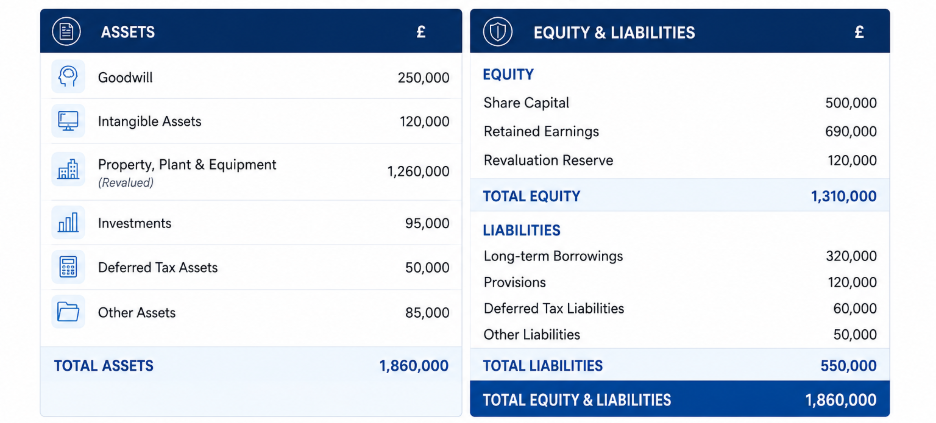
The financial statement impacts of revised FRS 102 are not confined to the accounting policies note. They change reported assets, liabilities, profits, and ratios in ways that affect how the business looks to everyone who reads the accounts.
Balance Sheet Impact
Total assets increase, and right-of-use assets are new additions. Similarly, total liabilities increase, and lease liabilities are new additions. Net assets may increase or decrease depending on the relative size of the asset and liability at transition. For companies with long leases and low discount rates, the assets and liability are broadly similar. For leases in later years, where the liability has unwound more than the asset has depreciated, the net position differs.
Net debt, as typically calculated by lenders and rating analysts, increases. Not because the business has borrowed more, but because the lease liability is now a recognised financial liability. This is the most commercially sensitive impact for companies with debt facilities that include leverage-based covenants.
Covenants, Lenders, and the Conversation That Cannot Wait
If the lease liability recognition creates a breach of a financial covenant, that conversation needs to happen with the lender. This ideally should be before the revised accounts are prepared, not after they are submitted. Lenders typically need to agree on a revised definition of the covenant measure.
Companies that discover a covenant problem in the process of preparing their 2026 accounts are in a materially weaker negotiating position than those who identified it in 2024 or early 2025 and addressed it proactively.
EBITDA, Margins, and Performance Metrics
EBITDA improves because operating lease charges, which currently sit above EBITDA, are replaced by depreciation and interest. For companies measured on EBITDA multiples, the revised standard produces a higher EBITDA from the same underlying trading performance. Whether that is treated as a genuine improvement or a presentational change depends on how the metric is defined in the relevant agreement.
- Operating margin changes: some contracts recognise revenue differently, some cost profiles change.
- Return on assets changes: both the numerator and denominator are different.
- Earnings per share may change: the P&L profile of leases changes.
All of these need to be understood, explained, and communicated before they appear unexplained in the accounts.
Final Thoughts
For companies where transition work is in progress, the priority list should be very systematic.
The first thing to do is gather lease data. Every lease the company holds as lessee needs to be identified, with the key terms like commencement date, lease term, payment schedule, options, and break clauses. Next, calculate the opening position. Right-of-use assets and lease liabilities need to be calculated for each in-scope lease. The discount rates need to be determined and documented. The transition adjustments need to be calculated and posted.
For material contracts, the requirement is to review against the five-step model. Where the pattern of recognition changes, the impact on the comparative period needs to be quantified. Where variable consideration is present, the constrained revenue figure needs to be calculated and compared with what was previously recognised.
Another key step in the process is to update systems and processes. Concerns should be if your accounting system cannot produce right-of-use asset and lease liability schedules. In any of these cases, the system either needs to be updated, or a parallel process needs to be built.
And finally brief the board. The financial statement impact should not be a surprise when the 2026 accounts are presented. The board needs to understand what is changing, why, and what it means for how they read the accounts going forward.