In 2026, CPA firms with advisory services will be offered flexibility under the new clarification from AICPA. That, CAAS providers, doesn’t necessarily require them to meet the strict compliance requirements under SSARS 27. Rather, they can categorize their advisory services under the regulations of CS 100, saving CAAS providers from an intensive administrative and documentation workload.
As a business grows, the finance function needs to evolve alongside. Accurate books and clean tax filings stop being the finish line and become the starting point. What owners need at that stage is a different set of eyes. They want timely insight into performance, forecasts they can act on, and someone who can help them read the numbers before they make a call.
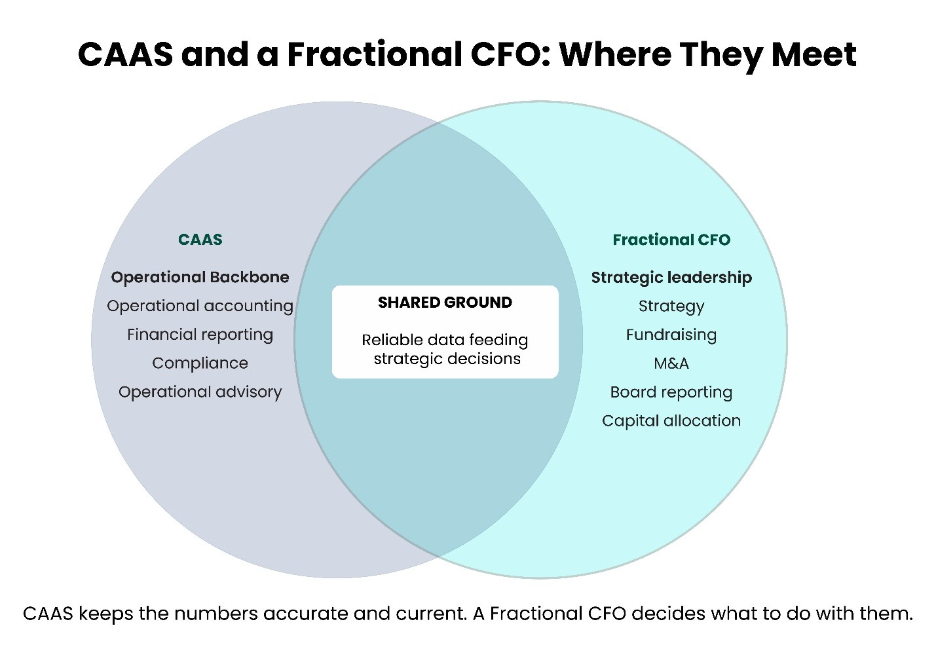
“CAAS keeps the numbers accurate and current, while a Fractional CFO decides what to do with them.”
These services are generally positioned as substitutes for each other, and there lies much of the misunderstanding regarding their use. They are not substitutes for one another. They occupy different levels within the financial function hierarchy, and in most cases where companies are growing, they complement one another. This piece sets out what each one does, where each earns its keep, and how a business owner can tell which they need.
| Finance leadership at a glance (US) | Figure |
|---|---|
| Number of small businesses in the US | 36.2 million, almost 99.9 percent of total number of US businesses (Office of Advocacy, SBA, 2025) |
| Share of jobs offered by small businesses in the private sector | Approximately 46 percent (Office of Advocacy, SBA) |
| Fastest growing services sector in the public accounting | Client advisory services, growing at 17% median (2024 CPA.com and AICPA PCPS CAS Benchmark Survey) |
Sources: SBA Office of Advocacy (2025); 2024 CPA.com and AICPA PCPS Client Advisory Services Benchmark Survey.
The backdrop matters. The small business comprises 99.9 percent of the total number of businesses in the United States, and it accounts for almost half of the workforce employed by private companies, according to the Office of Advocacy at the Small Business Administration (SBA). Almost none of them can afford an entire finance department right from the beginning.
What is Client Accounting and Advisory Services (CAAS)?
CAAS is a service line offered by accounting firms that pairs the operational side of accounting with ongoing advisory. The name says it plainly: client accounting and advisory. The accounting section includes bookkeeping, payroll, accounts payable and receivable, financial reporting, controller services, budgeting, KPI reporting, and cash flow. The advisory section is the place where the good provider earns its retainer by translating the numbers into information that the management could use.
The exact scope varies by firm. Some CAAS providers also offer virtual or outsourced CFO services, but that is not a given. Many treat it as a premium or separate line rather than something baked into every engagement. A business shopping for CAAS should ask what advisory actually includes before assuming strategic leadership comes with it.
The position itself has evolved over the last decade. Contemporary CAAS solutions have helped shift the focus of the accountants’ activity from that of simple recording to becoming a financial advisor offering up-to-date insights and providing performance information and advice. Providers use different platforms depending on the client’s needs: Microsoft Dynamics 365 Business Central, NetSuite, Sage Intacct, QuickBooks, among others.
That shift shows up in the numbers. Client advisory services is now the fastest-growing service area in public accounting, with participating firms reporting a median growth rate of 17 percent in the 2024 CPA.com and AICPA PCPS CAS Benchmark Survey. The growth is coming from firms doing more genuine advisory work rather than one-off tax cleanup, which tells you where the demand is heading.
For the business itself, the model gives access to professional accounting, reporting, and advisory capability without the cost of building a full in-house team. As the company grows and its questions get more strategic, many owners keep the CAAS function and add a Fractional CFO on top of it.
One point is worth clearing up, because it trips people up. CAAS advisory is real advisory. It just looks different from what a dedicated CFO provides.
It is commonly delivered by experienced accounting professionals, controllers, advisory managers, or shared finance leaders, depending on the firm’s service model. The focus is on explaining what the numbers mean and recommending operational improvements.
What it usually does not do is own the big strategic decisions. That line matters, and the next sections draw it clearly.
What is a Fractional CFO?
A fractional CFO is an accomplished finance professional who offers strategic guidance in a fractional or project capacity. It ensures the firm receives the wisdom of an accomplished CFO without having to make a costly full-time investment. The easiest way to understand what it means is through the example of a strategic partner who shows up for the critical decisions without the full-time costs.
The work is executive-level and forward-looking. It runs across long-term performance, capital use, profitability, risk, and growth. The key role of the Fractional CFO is to translate data into strategies and generate value through them. The element of trust plays a huge role in this process, but it serves as the bedrock of the process rather than the end goal. Owners hire a Fractional CFO for judgment and results, and trust is what lets them act on the advice.
This is where the role separates from bundled accounting advisory. A Fractional CFO’s entire engagement is strategy. They are not reconciling accounts between conversations. They tend to sit inside the leadership team, join board meetings, lead conversations with investors, and work through deals. The guidance is built around one specific business rather than pulled from a standard playbook applied across a portfolio of clients.
What is the Difference between CAAS and a Fractional CFO?
Altitude is the cleanest way to think about it. However, both roles contribute towards enhancing the financial performance of an organization. The difference is in how high up each role operates. The CAAS service firm creates the financial framework, including accounting, reporting, key performance indicators, and operational guidance. On the other hand, the Fractional CFO utilizes the dependable information in formulating strategies.
“Good accounting shows a business where it has been. A Fractional CFO helps it decide where to go next.”
In actuality, these two processes complement each other. Whenever CAAS provides correct and precise figures, then the Fractional CFO is left with time for analysis and strategizing. A strong CAAS function actually makes a Fractional CFO more valuable, because every recommendation rests on figures the leadership team can trust.
It is useful to be specific about the point at which advisory services end, and strategic planning takes place. The current CAAS does have some recommendations to give, and good CAAS providers will usually assist their clients in increasing their gross margins, reducing days of sales outstanding, freeing up working capital, optimizing inventory, improving pricing, reducing overhead, and increasing EBITDA. It is part of the CAAS’s job to plan the next move for their client. There are other things that CAAS does not control, such as overall company strategy. That is the Fractional CFO’s territory.
The table below sets the two side by side.
| Category | CAAS | Fractional CFO |
|---|---|---|
| Core focus | Day-to-day accounting, bookkeeping, and compliance, layered with advisory support | High-level financial strategy, growth planning, and executive decision-making |
| Advisory style | Interprets the numbers through benchmarking, trend analysis, and standard frameworks | Develops strategy through forecasting, financial modeling, and executive decision-making |
| Typical services | Bookkeeping, payroll, tax compliance, financial statements, KPI dashboards, budgeting support, and operational advisory | Cash flow forecasting, fundraising support, M&A guidance, board reporting, scenario planning, and strategic leadership |
| Month-end close | Manages and oversees the close to keep records accurate and timely | Reviews results to spot strategic trends, risks, and opportunities |
| Budgeting | Assists with annual budgets, budget tracking, and variance reporting | Builds strategic budgets, long-term financial plans, and forecasting models |
| Internal controls | Sets up accounting processes, financial controls, and compliance procedures | Evaluates financial risk and governance to strengthen decision-making |
| Management reporting | Prepares recurring statements, KPI dashboards, and operational performance reports | Uses those reports to advise leadership on priorities, profitability, and growth |
| Board reporting | Provides financial data and supporting reports for leadership as needed | Prepares and presents board- and investor-level reports and strategic recommendations |
| Level of engagement | Ongoing operational support, usually monthly or bi-weekly | Strategic and periodic, often tied to specific initiatives or milestones |
| Team structure | A team of accountants and bookkeepers, sometimes with a controller or virtual CFO layer | A senior finance executive, occasionally supported by analysts |
| Best for | Businesses that need consistent, accurate financial operations with some advisory support | Businesses that need executive-level leadership without a full-time CFO |
| Structure of cost | Generally smaller, proportional to the volume of transactions | Larger, proportional to strategy and number of hours devoted |
| Approach to reporting | Traditional approach, reporting past and current performance-oriented | Strategic approach, forward-looking |
| Business stage | New companies to medium-sized companies creating financial systems | Growth-oriented businesses or complex businesses |
The pattern in the chart is consistent. In one respect, the CAAS makes sure that the company’s finances work effectively and cohesively; in another respect, the Fractional CFO figures out how to use it. This is the same for all the rows in the matrix.
For those who want to see things quickly, below is a matrix showing ownership.
Where both columns are checked, the two work on the same information from different angles.
| Activity | CAAS | Fractional CFO |
|---|---|---|
| Bookkeeping and payroll | ✓ | |
| Tax compliance | ✓ | |
| Month-end close | ✓ | |
| Financial reporting | ✓ | |
| KPI dashboards | ✓ | |
| Cash flow forecasting | ✓ | ✓ |
| Budget planning | ✓ | ✓ |
| Capital raising | ✓ | |
| M&A and deal support | ✓ | |
| Investor and board reporting | ✓ | |
| Long-term financial strategy | ✓ |
The overlap in the middle rows is the point. Forecasting and budgeting share ground, which is exactly why the two functions work well side by side rather than in competition.
When Does a Business Need CAAS?
CAAS is ideal for companies that require a flexible and efficient finance department but do not want to establish an extensive in-house accounting department. Accounting, Audit and Assistance System offers services that include accountancy, auditing, assistance, and regular consultation, thereby guaranteeing that all information is precise and current. In other words, this means that the data collected becomes useful in making informed decisions concerning their operations. Whether a company is scaling fast, absorbing more complexity, or modernizing an aging finance process, CAAS brings the expertise, technology, and structure to strengthen how the business runs its money. The signs that a company has reached that point tend to look like the following.
The financial records are inconsistent or outdated
However, in case of reconciliation errors, payroll has to be done manually, and the accounts remain open for months. In such a scenario, the management will be flying blind, and planning and forecasting become difficult for the company. At times of tax or during loans and investments, clean documents become essential. CAAS creates this basic structure so that the leaders know where they stand.
The company is growing but does not need a full finance department
The hiring of a full-time controller, bookkeeper, and payroll administrator is costly, and the vast majority of small businesses are not yet big enough to justify such expenditure. The CAAS system offers the entire accounting department to a business at a significantly lower cost than hiring an individual in the office.
Management needs better visibility into performance
It is quite common to have entrepreneurs who know what they are making but cannot provide answers about margins, runway, or what departmental divisions are really turning a profit. The CAAS provides dashboard and KPI monitoring services, and reporting helps to paint a picture from the transactional data provided.
The business needs guidance alongside the accounting
Sometimes the need is not a full-time executive but someone who can help interpret the numbers as they land. Many CAAS providers include an advisory layer that flags trends, benchmarks against comparable businesses, and answers the financial questions that come up week to week. It will not replace deep strategic planning, but for a company not yet facing major strategic decisions, it is often exactly enough.
Compliance and financial risk are getting more complex
More revenue means more regulation, from multi-state tax obligations to sales tax nexus and state payroll rules. CAAS providers absorb that load, keeping the company audit-ready and clear of avoidable compliance problems.
Case Study: Building a Financial Foundation Before Scaling
Business background
The manufacturer was consistently growing for three years. There were always increasing demands and thus increasing complexities in its dealings. The company was earning profits, but the finance department was lagging behind the other departments.
Challenges
The in-house accounting staff was limited and thinly stretched. Financial figures for the end of each month would come in two or three weeks late, meaning that decisions on inventory and hiring were made based on outdated figures. There was poor visibility into cash flow, manufacturing costs, and product margins. Building out a full in-house finance department, though, was not yet economically justified.
How CAAS helped
The organization hired a CAAS provider in order to boost its finance department instead of replacing it. The provider made accounting processes easy, minimized the time required to close books by the end of each month, ensured that proper internal controls were implemented, and provided proper reporting mechanisms and dashboards for management. This helped in making sure that management had proper visibility and decision-making capabilities based on facts.
A typical before-and-after for an engagement like this:
| Metric | Before | After |
|---|---|---|
| Month-end close | 15+ days | Under 5 days |
| Management reporting | Ad hoc | Monthly dashboards |
| Cash flow visibility | A week or two out | 13-week rolling forecast |
| Forecast updates | Rarely | Monthly |
Illustrative figures for a representative engagement, not a specific client.
Outcomes
The stronger foundation paid off when the company moved to finance a new production plant. As the books were in good order and the reporting was done well, the Fractional CFO that was brought in at a later stage had the ability to focus on more valuable tasks like capital planning, funding alternatives, bank negotiations, and growth strategy. The CAAS team built the structure, and the Fractional CFO built on it.
When Should a Business Hire a Fractional CFO?
A Fractional CFO brings the experience of a senior finance chief to a company on a part-time or project basis. The value is not in saving on salary. It is in having someone who can look past the mechanics of accounting and tell management what the financial picture means for the decisions in front of them. When a company is going through a major change or a fast expansion, that judgment is often the difference between a good decision and an expensive one. The cost savings compared with a full-time hire are real, but they are a side benefit, not the reason to make the call. The situations below are where a Fractional CFO tends to earn back the fee several times over.
The business is raising capital
Investors and lenders want more than clean books. They want financial modeling, credible forecasts, and a coherent story behind the numbers. A Fractional CFO builds the model, anticipates the questions capital providers will ask, and often sits at the table during negotiations. That gives the company far stronger footing in the conversation.
A major transaction is on the horizon
Valuation, due diligence, deal structuring, and negotiation surface financial issues that are easy to miss until they bite. A Fractional CFO who has navigated these deals before knows where the risks hide and how to steer the process in the company’s favor.
The company needs board- or investor-level reporting
Boards and investors expect reporting that looks forward, tells a story, and ties directly to strategy, well beyond a standard monthly statement. A Fractional CFO produces exactly that and can represent the business credibly in those rooms.
The financial questions have gotten complex
How should a new product line be priced? Lease or buy the equipment? Where does capital go when several opportunities compete for it? Is a new market worth entering? Each of these carries real financial risk, and a Fractional CFO brings the analysis to answer them with confidence.
The business needs a strategy for future growth
Beyond any single question, there are times an owner simply needs a trusted person to help shape financial decisions for the years ahead. Planning several years out is hard to do well without that kind of experience in the room.
Case Study: Turning Financial Strategy into Funded Growth
Business background
A regional distribution company had grown steadily for five years with a CAAS provider handling its accounting. The books were in good shape. Monthly reports were accurate and on time, and management had clear visibility into cash flow and operations. Demand was still rising, and the company wanted to move into new markets.
Challenges
The data was reliable, but the leadership team could not turn it into a financial strategy for that expansion. They could produce last month’s numbers on demand, yet when a lender asked for a three-year forecast and a downside scenario, no one in the business could build one. They also needed to decide how to finance the move while protecting profitability and cash flow. Those are strategic finance questions, and a full-time CFO was not yet justified.
How a Fractional CFO helped
The company brought in a Fractional CFO to lead financial strategy through the expansion. The CFO built long-term forecasts and investor-ready models, weighed the funding options, and prepared board-level reporting that tied financial performance to the growth plan. They also worked directly with lenders and investors, helping management present a clear, credible strategy backed by solid numbers.
A typical before-and-after for a case like this:
| Capability | Before | After |
|---|---|---|
| Funding model | None | Investor-ready model |
| Forecasting | Last month’s actuals | Three-year forecast with scenarios |
| Lender conversations | Informal | Structured financing process |
| Capital plan | Undefined | Board-approved strategy |
Illustrative capabilities for a representative engagement, not a specific client.
Outcomes
With that strategic leadership in place, the company secured the financing it needed and moved into its new markets with a plan it could defend. Leadership came away more confident in its capital decisions and its longer-term cash flow planning. The reliable CAAS foundation made the work possible, and the Fractional CFO’s strategy is what turned it into funded growth.
When Does a Business Need Both?
CAAS and a Fractional CFO do different jobs, but they are not mutually exclusive. Many growing businesses get the best result by running both together. As a company expands, its finance function tends to mature in stages, though the path is rarely as tidy as a straight line.
A common progression looks like the table below. Plenty of businesses skip a stage or blur two together, and CAAS itself can be delivered by an experienced accountant, a controller, or a shared finance leader depending on the firm, so no single ladder fits everyone.
| Business stage | Typical finance support |
|---|---|
| Startup | Bookkeeping |
| Early growth | CAAS |
| Scaling | CAAS plus controller-level oversight |
| Expansion | CAAS plus a Fractional CFO |
| Fundraising or acquisition | CAAS, a Fractional CFO, and specialist support |
Oversight is what holds the middle stage together, whether it comes from a controller or another experienced finance lead. Someone needs to own the month-end close, reporting, budgeting, and internal controls so the numbers are accurate and ready to use before they feed strategic work. Once that layer is solid, a Fractional CFO can focus on long-term planning, capital allocation, fundraising, and growth.
There is also a benefit that gets overlooked. A good CAAS engagement does not just keep the books, it redefines and leans out the underlying processes, cutting waste and manual effort so the finance function runs faster and cleaner. That process work is part of what makes the later strategic work possible.
A business is likely to benefit from combining these services when:
- Its accounting processes are well established and it is preparing for rapid growth or expansion.
- Its daily bookkeeping and financial workflow need to be streamlined and made more efficient.
- Its finance operations need stronger oversight through a structured close, budgeting, management reporting, or internal controls.
- It needs accurate reporting to support strategic planning and executive decisions.
- It is raising capital and needs both reliable statements and investor-ready models.
- It runs multiple locations, entities, or revenue streams that call for tighter financial oversight.
- It wants to improve operational efficiency while building a long-term growth strategy.
- It is preparing for a merger, acquisition, or exit and needs both operational finance support and executive leadership.
Final Thoughts on CAAS vs CFO
The practical way to frame the choice is by the question a business is trying to answer. CAAS answers whether the numbers are right, current, and telling the business what it needs to know. A Fractional CFO answers what the business should do next, given those numbers. A quick rule of thumb:
| If the main challenge is… | Best starting point |
|---|---|
| Cleaner books and reliable reporting | CAAS |
| Better visibility into performance | CAAS |
| Raising capital or refinancing | Fractional CFO |
| An acquisition or an exit | Fractional CFO |
| Long-term growth strategy | Fractional CFO |
| Scaling fast with complex operations | Both |
For most companies the sequence is natural. Get the foundation right first, because strategy built on unreliable data is guesswork. Once the accounting is dependable and the reporting is clear, bring in strategic leadership when the decisions justify it, whether that is fundraising, expansion, a transaction, or a board that wants more than a monthly statement. Some businesses need only CAAS for years, and others reach the point where a Fractional CFO pays for itself quickly.
The better question is not which service wins, but which one the business needs for the decision in front of it.