
Quick Summary
Healthcare Practices can benefit greatly from a CAAS model. It helps improve financial visibility and forecasting ability. The most optimal time for a healthcare provider to opt for a CAAS provider is during a transition period or when certain gaps in their financial strategy are identified.
Healthcare accounting is considered one of the most complicated aspects of financial management. This is due to constantly changing reimbursement methodologies, strict regulations, and complex interactions between providers and payers. As the practice grows, dealing with such complexities becomes increasingly costly. It requires considerable expenditures on revenue cycle management, accounting, and financial management. In accordance with the scope of the business, simply having in-house RCM may cost hundreds of thousands of dollars per year. Nevertheless, all these investments serve only as means of ensuring normal operations, billing, and compliance, leaving no money for strategic planning aimed at growth and profitability.
At the same time, many healthcare organizations have finance departments and CFOs who ensure proper healthcare finance management services and financial planning. However, the creation and maintenance of such capacities is costly, especially for smaller or medium-sized practices.
As a consequence, more and more healthcare organizations are starting to use the new method of accounting called Client Accounting and Advisory Services (CAAS). Instead of simple bookkeeping and compliance, CAAS provides constant financial analysis, cash flow forecasting, performance reporting, and advice for decision making.
This blog explores what CAAS is and why it is becoming increasingly valuable for healthcare practices. It also examines how this model supports financial and operational performance and what to consider when selecting the right service provider.
Why Traditional Accounting Falls Short?
At its core, traditional accounting is designed to record what has already occurred through transactions and the preparation of financial statements. It also involves managing tax issues and ensuring compliance with relevant regulatory requirements. These are certainly essential activities; however, they talk about the past and not the present or the future. When an owner receives a month-end report, it is too late because any problems revealed in this document have had enough time to develop.
These healthcare accounting challenges are especially serious since reimbursement cycles change unexpectedly, and patient flows cannot be anticipated. Costs grow as a result of staffing constraints, and the constantly changing regulations affect the billing and reimbursement procedures. Important decisions like hiring a doctor, opening an office, buying equipment, and choosing services, which have major financial impacts, can’t be based on last month’s info. To make these decisions, current information, forecasts, and consultants are needed.
What is Client Accounting and Advisory Services (CAAS)?
Client Accounting and Advisory Services is a finance model built around the idea that accounting should be continuous and strategic, not periodic, and compliance driven. Instead of receiving a set of reports at the end of each month and being left to draw their own conclusions, practices working with a CAAS provider benefit from an ongoing financial partnership. They also gain from real-time reporting with proactive monitoring and advisory support that help leadership make decisions with confidence rather than guesswork. The following table illustrates how that compares to the traditional approach:
| Traditional Accounting | CAAS |
|---|---|
| Historical financial reporting | Real-time dashboards and reporting |
| Tax preparation and compliance | Strategic financial planning |
| Month-end reporting | Continuous financial monitoring |
| Compliance-focused | Growth and performance-focused |
| Reactive support | Proactive financial guidance |
How CAAS Supports Healthcare Practices
Healthcare organizations face financial pressures that most other industries do not encounter at the same scale or complexity. These include delayed insurance reimbursements, fluctuating patient volumes, rising labor costs, and capital demands that require careful, forward-looking planning. Accurate bookkeeping alone isn’t enough to navigate that environment effectively. What practices need is a financial model that combines reliable accounting with timely insights and strategic guidance. CAAS delivers on all three fronts, giving healthcare leaders the tools to stay ahead of financial challenges rather than responding to them after the damage is done.
Real-Time Financial Visibility
One of the most immediate differences practices notice when moving to a CAAS model is how differently financial data flows. Rather than waiting for a monthly close to understand the current situation, leadership now has access to live dashboards. These dashboards pull in data from accounting, billing, payroll, and practice management systems simultaneously. Cash position, accounts receivable aging, revenue by provider or specialty, payroll and operating costs are all visible when it matters, not weeks later. The budget versus actual performance is also accessible.
Cash Flow Forecasting
Insurance reimbursements rarely arrive on a tidy schedule, and patient volume has its own rhythm that doesn’t always align with operational expenses. Traditional accounting can tell you what’s in the account today; it can’t tell you whether that balance will hold through next month’s payroll or a planned equipment investment. CAAS addresses that gap through ongoing cash flow forecasting using historical patterns and current data to project the practice’s financial trajectory. This allows for better planning of payroll runs, vendor payments, and larger expenditures by providing a clearer picture of upcoming cash flow.
Revenue Cycle Performance Monitoring
All aspects of billing and collections impact the practice’s bottom line in some way. Issues with the revenue cycle tend to accumulate gradually, often unnoticed until they become significant. CAAS is constantly monitoring the key performance indicators such as the following to identify any inefficiencies that might cause cash flow difficulties:
| Key KPI | What It Measures |
|---|---|
| Days in Accounts Receivable | How efficiently the practice is collecting payments |
| Claim Denial Rate | Frequency of rejected claims and billing accuracy |
| Net Collection Rate | Percentage of owed revenue actually recovered |
| Average Reimbursement Time | How quickly payers are processing and paying claims |
| Patient Collection Rate | Effectiveness of collecting balances owed by patients |
Budgeting and Strategic Planning
A static annual budget has a short shelf life in an environment that changes as quickly as healthcare does. CAAS supports a more dynamic approach to ongoing budgeting, rolling forecasts, and financial modeling that reflect current conditions rather than assumptions made twelve months ago. When leadership is weighing a significant investment or planning expansion, they can do so against financial projections that are actually current, which changes the quality of those decisions considerably.
When Should a Healthcare Practice Consider CAAS?
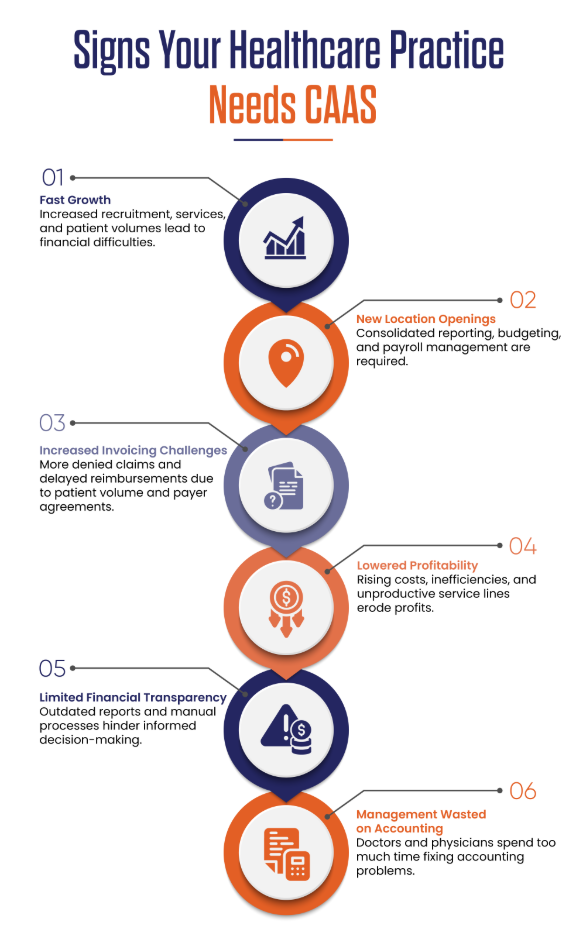
There will always come a time for each healthcare practice where accounting alone won’t suffice in meeting their financial requirements. As an organization grows and evolves, financial matters become more complicated, requiring greater transparency and more advanced reporting. Conventional accounting systems often cannot support the executive-level decision-making needed in this stage. The problem with this point of no return is that it tends to come slowly enough that we miss it until financial management starts being reactionary rather than strategic. By spotting the red flags early, practices have a chance of making the switch in advance, without suffering a lack of financial oversight impacting their cash flow or profits. Below are some of the most typical signs that your healthcare practice could use CAAS.
How to Choose the Right CAAS Partner?
Selecting the right CAAS partner goes beyond mere acquisition. In truth, making this selection could have profound effects on the success of your healthcare company. An experienced partner not only comes with strong technical skills in accounting, but he or she also has an in-depth knowledge of the inner workings of the healthcare industry. With such knowledge, he or she can give advice that is relevant and practical. The advice that you get from such a partner can go a long way in optimizing your financial process and achieving success.
- Expertise in the Healthcare Industry: The field of healthcare accounting stands out from the crowd. Issues related to insurance reimbursement, RCM dynamics, provider compensation schemes, and regulations on billing are very specific. An expert who deals mostly with other industries lacks the context to be able to make good recommendations.
- Technology Integration: Today’s CAAS requires a good integration of technology platforms. It is therefore essential to seek a vendor who can ensure seamless integration with your EHR, billing, payroll, and practice management software and ensure you get real-time dashboards and automatic reports as a default feature. This will help avoid multiple sources of financial information and eliminate the need for reconciliations.
- Security and HIPAA Compliance: Financial information within the healthcare industry is never separate from patient information, and it raises some compliance issues. It is important to find a vendor that has good cybersecurity, role-based access control, and a clear data protection policy.
- Advisory Depth: Reporting is only valuable if someone helps you understand what it means and what to do about it. The best CAAS partners offer cash flow forecasting, profitability analysis, KPI benchmarking, and fractional CFO-level guidance, and they bring those insights to the table proactively rather than waiting to be asked.
- Scalability: A practice that’s growing will have different financial needs in two years from now than it does today. The right provider scales with you, handling more complex reporting, higher transaction volumes, and multi-location management without requiring you to start over with a new system or partner.
- Communication Model: The most technically capable CAAS provider still falls short if the communication isn’t there. Regular financial reviews, dedicated points of contact, proactive check-ins, and planning conversations that look ahead rather than just recapping the past are all markers of a partnership that will actually deliver on its promise.
Key Takeaway
As mentioned in the above blog, current healthcare practices operate in a very complex and dynamic economic environment. Relying only on traditional accounting processes cannot properly control this environment. Reimbursement models continue to evolve; costs keep rising, and the decisions that will determine whether or not the practice continues to grow require financial knowledge that cannot be provided by the monthly report. On top of that, doctors and practice owners do not have enough time to handle all other responsibilities, including patient care, employee management, and operations. Consequently, there is no time left to address financial challenges or to piece together the bigger picture.
CAAS model is designed to break that vicious circle. It combines traditional accounting with advanced tools like real-time control, forecasting, and strategic consulting. These enable healthcare professionals to gain insights into their financial performance and take appropriate actions before issues become critical. No matter how fast-growing your practice is or how many locations it includes, the CAAS model can provide the necessary tools and expertise to manage it. If you want to build a financially strong practice, the CAAS model is definitely worth considering.