
Quick Summary
Efficient onboarding moves clients seamlessly from agreement to an active working relationship. By setting clear communication cadences, defining service scopes, and confirming expectations, firms guide clients toward trust, guaranteeing higher retention rates and smoother engagements.
The onboarding process is the first impression a CPA firm makes on a client, which sets the tone of the entire service exchange. This is the phase where expectations are established, the cadence of the communication is set, and deliverables are decided upon.
However, it’s also the areas that many CPA firms neglect to understand their importance. This is because they are overly focused on the services being offered and treat onboarding as a back-office administrative function.
An efficient client onboarding process is one where the clients will feel appreciated, trusted, and understood. Studies have shown that clients who undergo an effective onboarding process are more likely to form a long-term relationship with the firm.
To create such an effective onboarding process, there is a need for CPA firms to develop an efficient process to guide their clients towards trust. This trust is built upon clients being able to predict timelines, deliverables, and communication touchpoints.
This blog provides an in-depth guide on building a CPA firm’s CAAS client onboarding best practices. To ensure you establish your client interactions for long-term success from the get-go.
What Happens During Client Onboarding?
The client onboarding process is the stage between signing an agreement, during which the client and the CPA firm have reached an understanding. It precedes the stage where the CPA firm delivers strategic advice to the client. This vital gap mainly entails ensuring that there is goal alignment for both parties.
During this process, the client provides comprehensive historical financial data and grants digital access credentials to relevant accounting platforms. Additionally, they complete detailed intake questionnaires. These steps are essential to facilitate a thorough understanding of the client’s financial situation and objectives.
Meanwhile, the CPA firm conducts preparations on its end by establishing the necessary internal infrastructure. This includes technological systems and operational protocols to support efficient service delivery. The company also creates operational guidelines to make sure that onboarding, communication, and assistance are carried out without any hiccups. In order to provide a more concrete idea of what the onboarding process involves, the following portion gives an elaborate example of an efficient onboarding process.
Client Onboarding Guide for Client Accounting and Advisory Services
An ideal onboarding procedure for client accounting and advisory services in accounting is one that achieves three levels of goals: Operational Alignment, Technical Integration, and Strategic Enablement. Here is what the procedure looks like:
Kickoff and Alignment
The client onboarding process starts with an introduction, typically in the form of an “Engagement Letter” or a “Welcome Aboard” message. This initiative is sent through the preferred mode of communication. The communication should include an introductory message that involves a greeting, high-level onboarding schedules, and an introduction to the client’s point of contact or field work team. Setting a schedule for consistent communication that will either be a weekly touch base or the date for the first working session.
Discovery and Data Gathering
Once the kickoff is complete, the firm initiates a thorough discovery phase. This involves sending clients secure document request lists to gather historical tax returns, previous financial statements, and organizational charts. The CPA firm reviews this data for discrepancies and assesses any historical cleanup or catch-up work required. This step also involves conducting standard Client Verification and Anti-Money Laundering (AML) checks if necessary.
Technical Implementation
This phase zeroes in on system integration. The firm ensures that the client’s accounting software is successfully connected to the firm’s practice management and advisory tools. The client grants the firm the appropriate permissions. The CPA team then configures bank feeds, sets up the chart of accounts mapping, and tests secure client portal access to facilitate frictionless collaboration.
Workflow Configuration
With the technical setup established, the CPA firm formalizes the internal workflow. The process will include allocating internal employees, creating deadlines for each assignment, and developing task lists for the company’s internal dashboard. Creating such internal structures will ensure that tasks like bookkeeping, payroll, or tax filing become automated processes that do not require continuous supervision.
Review and Handoff
The final step solidifies the relationship by delivering the first major milestone or initial financial assessment. The CPA firm reviews the initial data with the client and, if applicable, provides a baseline report, such as an initial cash flow forecast. The process concludes with a handoff meeting. During this meeting, the client is introduced to their long-term customer success or continuous engagement team to guarantee an exceptional user experience.
How to improve the client onboarding process?
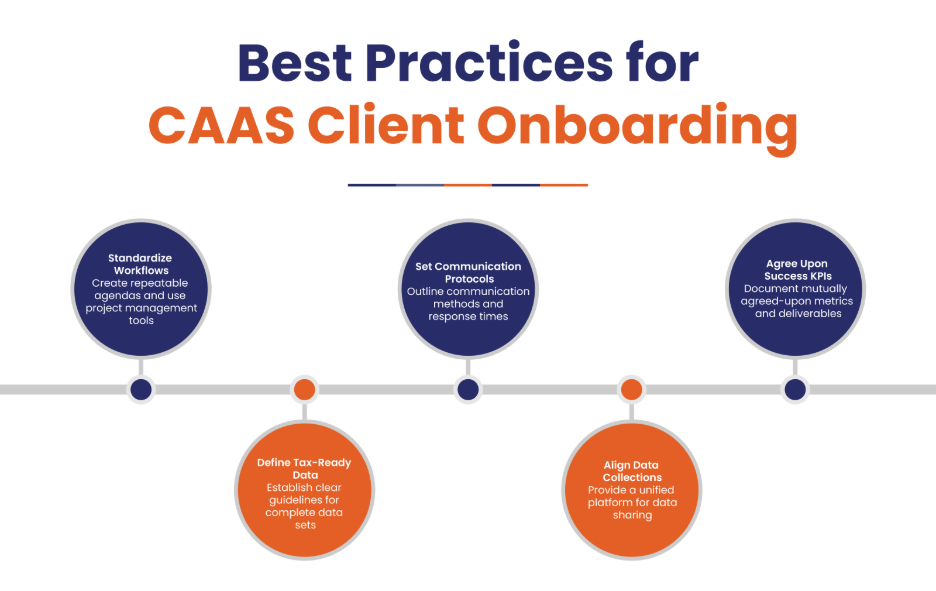
Improving the advisory client onboarding process involves CPA firms incorporating certain CAAS client onboarding best practices that build upon the pillars of the onboarding process. These enhancements aim to make the process more efficient, convenient, and insightful for the client. The following section lists some of those best practices that every CPA firm must incorporate during the onboarding process for their advisory client. Getting a new client into an advanced advisory capacity entails a systematic process of white-glove treatment. For purposes of efficiency and convenience in the intake and integration process, the following are client onboarding best practices:
What are the 5 C’s of effective onboarding?
The 5C’s of onboarding for a CPA firm refer to a set of fundamental principles that CAAS client onboarding best practices include for bringing new clients into the firm. These principles offer a structure that ensures an efficient and effective entry process for any new client to the services offered by accounting and advisory firms. Following these 5C’s helps the firms to build trust and credibility with their clients right at the start of the business relationship. Not only does this help in building a good first impression, but it also makes operations more efficient by streamlining procedures. Overall, implementing the 5C’s ensures that client onboarding is thorough, professional, and aligned with the firm’s goals for long-term success. The following section lists what 5Cs is and what it looks like for CPA firms towards their advisory clients:
Compliance
Compliance is the foundational step of client onboarding and centers on mitigating risk and meeting regulatory requirements. To the firm, it involves performing routine client verifications and ensuring proper engagement letters that specify the scope of services. Additionally, it includes obtaining the necessary legal or tax permissions. This way, the firm can be assured that they have carried out their paperwork properly and avoid any future legal hassles.
Clarification
This means avoiding ambiguity and clearly laying down the limits. For advisory clients, clarification entails identifying the deliverables needed, identifying the key points of contact, and settling on the mode and time of response. It makes sure that the client is very clear about the deliverables expected from them concerning the data, thus making collaboration possible in an extremely predictable way.
Connection
Connection goes beyond the transaction and focuses on building a deeply personal, human relationship between the advisory team and the client. In the service context, this means ensuring clients feel recognized, heard, and supported by their dedicated financial professionals. Firms foster this connection through early welcome interactions, clear points of introduction to the advisory staff, and an open, collaborative environment where clients feel comfortable asking questions about their financial goals.
Culture
Culture guarantees that the values and objectives of the client coincide with those of the firm. The firm reveals its values through openness regarding how they work, how they make decisions, and their mission as a company. When the firm successfully incorporates the client into its own special service culture, an atmosphere is created in which the client feels valued and respected.
Confidence
Confidence is built by proving to the client that their financial future is in highly capable hands. CPA firms cultivate this by demonstrating deep industry expertise, showcasing secure data management systems, and efficiently guiding the client through their first deliverables. When clients see a smooth, organized process executed without unnecessary friction, their trust in the firm’s ability to resolve their pain points solidifies.
Checklists to ensure a smooth onboarding process for the client
For a CPA firm to guarantee that its strategic advisory client is seamlessly integrated into their systems, it requires a well-structured internal workflow. This workflow should be specifically designed to systematically check off all necessary steps. It should also proactively identify and eliminate any potential bottlenecks that could hinder a smooth onboarding process. The following section offers a comprehensive template of a detailed checklist that every CPA firm should utilize. This checklist is essential to ensure that they are delivering the highest quality services to their clients, even before the specific advisory services commence. Implementing such a detailed process helps in setting clear expectations, ensuring efficiency, and fostering strong, trust-based relationships with clients from the very beginning:
- Have we secured a signed engagement letter and an approved retainer?
- Did we review the client’s legal business structure (e.g., S Corp, LLC, Partnership) to ensure proper alignment with our advisory focus?
- Have we completed all necessary background and conflict checks to clear the client for onboarding?
- Did we send out our detailed intake questionnaire to capture the client’s current pain points, business goals, and operational challenges?
- Have we collected all necessary historical tax returns, financial statements, and payroll records?
- Are the client’s opening balances established and verified against their prior records?
- Did we send a “Welcome Aboard” message with a secure client portal link?
- Have we requested or been granted read-only access to their accounting software and banking feeds?
- Have we securely stored their software credentials in our centralized password manager?
- Are their profiles and billing configurations set up in our CRM and practice management system?
- Have we scheduled the official kick-off meeting to introduce our team and establish workflows?
- Did we clearly outline a communication plan that defines expected response times and preferred contact channels?
- Have we scheduled the first monthly review call to set immediate 30-day milestones and expectations?
Key Takeaways
For CPA firms that operate on a CAAS (Client Accounting and Advisory Services) model, an efficient client onboarding procedure is absolutely crucial. This process forms the basis for developing client relationships and makes sure that clients feel valued right from the start. The implementation of such a process helps improve the client experience while setting proper expectations and forming a solid ground for future communication. Through offering a smooth onboarding process, your firm proves its dedication towards satisfying the needs of the client and thus builds up trust and loyalty. In many cases, this stage of the engagement plays a major role in forming a perception of your services’ value.
Besides, a stable onboarding process may help increase the efficiency of the work of your firm. Because each stage of the onboarding procedure is clearly outlined, mistakes and misunderstandings are less likely to occur. This allows you to concentrate fully on working. Such an approach may be a significant source of savings regarding time and costs. Thus, your firm will have the opportunity to scale efficiently and grow successfully.