Revenue leakage seldom comes from one major mistake. It is often the result of missed invoices, outdated pricing, unbilled work, reconciliation gaps, disputed invoices, and delayed collections. This blog explains where these leaks often occur, how CFOs can identify them early, and the financial controls, reporting, automation, and processes that can help in preventing them.
Revenue leakage is hard to catch, even under careful financial oversight. An unbilled invoice, a scope change nobody billed for, a past-due account that keeps aging without collection or adequate follow-up. Each might appear like a small operational miss when viewed in isolation. But when these gaps repeat across customers, contracts, and billing cycles, they quietly hamper revenue, profitability, and even cash flow. Left unaddressed for too long, they result in a steady drain, as mentioned, even after the cash has arrived.
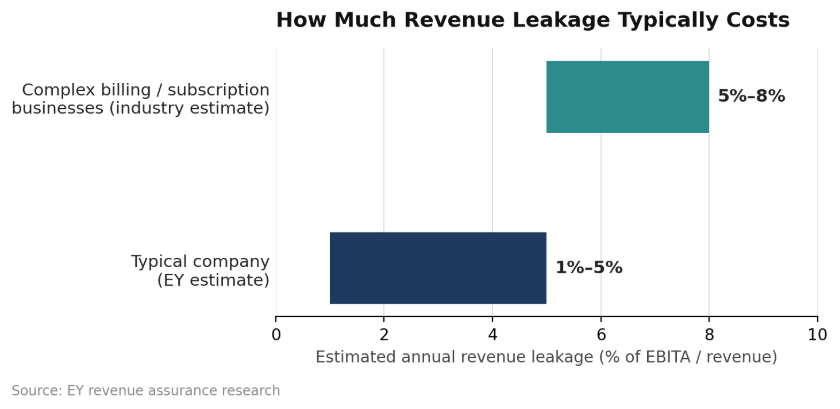
Nevertheless, the scale of the problem is better documented than most finance teams realize. In a 2020 international survey of more than 2,000 business leaders, Boston Consulting Group found that 45% called revenue leakage a systemic problem at their company, and 59% had no full-time staff dedicated to catching it. EY’s research puts the typical revenue leakage annual cost at 1% to 5% of EBITA, a range the same research shows widening to 5% to 8% of revenue in industries with complex billing and contract structures, such as professional services and subscription businesses.
If your finance team cannot quickly tell you whether everything delivered last month was actually invoiced, you have a revenue visibility problem, and potentially a revenue leakage problem. While technology can help identify missed billing and improve invoice tracking, implementing software alone is unlikely to solve the underlying issue. Sustainable revenue assurance also requires clearly defined billing processes, ownership, reconciliations, and controls.
It starts with fixing the handoffs between sales, delivery, and billing, since that is where most leakage originates. Where internal teams do not have the bandwidth to scrutinize every transaction, many businesses extend that capacity through outsourced accounting support that treats the transactional review as a full-time job rather than a task squeezed in between month-end close and the next audit.
This blog walks through why revenue leakage happens, what it looks like in a real business, how to identify it before it becomes material, and what a CFO can do to stop it.
What Is the Most Significant Reason for Revenue Leakage?
The most damaging revenue leakage rarely starts as one dramatic failure. It starts small: transactions that never get recorded, a customer still billed at an outdated price, and completed services that never make it onto an invoice. A missed $400 change order does not trigger an audit. Individually, these may seem insignificant. Over the course of a fiscal year, however, they can add up to a meaningful amount of revenue that the business earned but never captured.
These are six of the most common places where revenue leakage can occur, often without being immediately visible to the finance team.
| Root Cause | What It Looks Like in Practice | Typical Financial Effect |
|---|---|---|
| Missed invoicing & billing | The project has been completed or transferred, but the finance team has not been notified to issue the invoice. | Revenue that has been earned but not yet billed is included in the unbilled work-in-progress. |
| Delinquency & stale receivables | Unsettled invoices remain unpaid until the designated collection period has elapsed. | Cash flow pressure and an increasing reserve for bad debts |
| Rejected claims and contested invoices | Invoices and claims frequently face rejection, dispute, or require modifications, leading to additional work before payment can be received. | Delays in collections, higher DSO, and extra effort required for reconciliation and follow-up |
| Reconciliation gaps | Transactions and balances across the operating system, AR, bank, and accounting records do not match, leaving uncertainty over what has been billed, what remains outstanding, what has been collected, and what has been recorded. | Inaccurate revenue visibility and delayed reporting |
| Misapplied or stranded payments | Customer payments are applied to the wrong invoice or customer, or remain unallocated in suspense and unapplied cash accounts, creating inaccurate AR balances and additional reconciliation work. | Payments misapplied or stranded in a suspense account |
| Operational inefficiencies | Billable work, milestones, usage, or contractual changes are communicated late, inconsistently, or without supporting documentation | Billing depends on individual memory and manual follow-ups rather than documented, standardized processes. |
| Scope creep | Work performed outside the original contract never gets invoiced | Additional effort is absorbed without corresponding revenue, reducing the profitability of each engagement |
Missed Invoicing & Billing
The easiest place to begin is also the most common one: work is delivered, and no one creates an invoice for it. It most commonly occurs in cases where there is manual triggering of the invoice as opposed to automatic triggering based on achievement of milestones or delivery and usage limits. The project ends on Friday, the invoice should be delivered on Monday, and three weeks later, it becomes apparent in the finance department that there was never an invoice sent out for the last stage of the project. By the time this problem is identified, the relationship with the customer makes it difficult to bill for everything retrospectively, resulting in reduced revenue for the CFO.
Delinquency & Stale Receivables
Customers frequently delay invoice payments, often past the agreed collection period, which can eventually push receivables into bad debt. Delayed follow-up on overdue invoices by sales staff, account managers, and the collections department often results in receivables aging further, making collections significantly more difficult as time passes.
This has led to situations where unpaid invoices continue to pile up until the finance department steps in, at which point there may already be disagreements, making it difficult to collect on the payment and therefore incurring large losses. In practice, the account that is 15 days overdue is a phone call. At 90 days, the account becomes a negotiation, whereas at 120 days, the account gets written off. If you are handling a 90-day-old account in the manner that you would handle a regular follow-up, then the collection opportunity has long since passed.
Denied Claims & Disputed Invoices
Problems that occur during customer onboarding, master data creation, or invoicing could lead to claim denials and rejected payments. Likewise, errors in billing such as wrong pricing, billing levels, omission of billable items, or contract differences could lead to invoicing problems and the need for credit notes and payment renegotiation.
Reconciliation Gaps
Gaps often appear between what the operational system shows as billed revenue and what finance actually receives in the bank account. When invoicing data is not reconciled regularly across the CRM, the delivery system, and the general ledger, payments get applied to the wrong invoice, logged against the wrong customer, or left sitting in a suspense account nobody reviews on a fixed schedule. What should be a routine match between the bank feed and the AR ledger turns into a manual chase, and any payment that never gets matched to an invoice is effectively invisible on the P&L until someone goes looking for it.
Operational Inefficiencies
A large share of revenue leakage traces back to a simple handoff failure between the team closing new work and the team billing for it. When sales or delivery does not reliably communicate what was actually agreed, delivered, or changed mid-project, finance has no clean, timestamped record of billable activity to invoice against.
What Is an Example of Revenue Leakage?
One of the most common and least visible sources of revenue leakage is unbilled scope expansion. However, as requirements change, the delivery teams may engage in tasks outside the scope of the contract. Unless these tasks are properly documented, authorized, and communicated to the billing teams, they fail to appear on the bill. This kind of leakage is also caused when customers use more than their contracted usage, access extra services, or reach certain billing thresholds that were not recorded in the billing process. Since such leaks arise from several functions including sales, operations, project management, and finance, they stay unnoticed until it is too late.
The same blindness also manifests itself in untapped billable time, which is done but is not captured on any invoice, and in promotions which are extended beyond their planned expiration dates because no one has responsibility for turning them off. All three of these have a common root cause with scope creep, namely that something is transferred, but the billing process does not reflect this. The case study below shows exactly how that plays out on a single project.
Case Study on Fixing Scope Creep: Who à What à How
For a medium-sized website design company, a $10,000 fixed-price project ended up losing $3,500 to scope creep, unrecorded hours, and a hosting overage. Here is how the leak happened and what it cost.
Who
An average-sized web design company was awarded a fixed-price deal worth $10,000 for developing a new website that looks professional. The contract had clearly specified the scope of work, which included five pages and a basic contact form.
What
- Verbal scope creep: The client required three more landing pages and one booking plugin while the application was being developed. However, the project manager verbally accepted the request without amending the agreement or notifying the billing department.
- Lost working hours: Developers put in an extra 15 hours on these features but never recorded those hours because that work was considered to be within the scope of the project.
- Missing server expenses: Extra traffic from the staging server fell outside the free tier, but the additional hosting cost was not included in the final invoice sent to the client.
How
The project came in on schedule, and the client was satisfied with the finished site. Underneath that, three unbilled items quietly wiped out the agency’s margin.
| Leakage Source | Unbilled Amount |
|---|---|
| Unbilled scope creep (3 landing pages + booking plugin) | $1,800 |
| 15 unlogged development hours at $100/hour | $1,500 |
| Unbilled hosting overage | $200 |
| Total leaked | $3,500 |
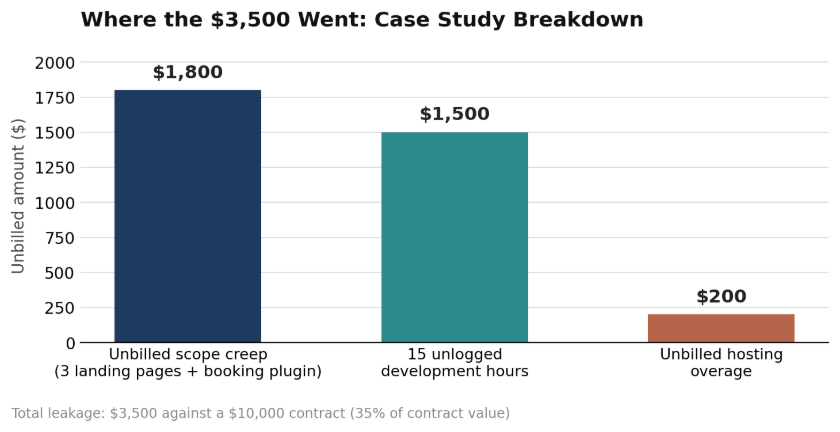
When considering a $10,000 contract, $3,500 of unpaid work represents a 35% reduction in profit margin, which can make the whole engagement barely profitable rather than highly profitable. None of the above three has anything to do with cheating or process failures; they only involve exactly what the majority of companies have but never recorded: an oral agreement, an unwritten timesheet, and an unnoticed hosting charge.
How to Identify Revenue Leakage
A CFO can identify revenue leaks through a structured review of pricing execution, contract terms, and billing workflows, rather than waiting for leakage to show up as a variance in the monthly financials. Pricing compliance, unbilled charges, and collection processes deserve particular scrutiny, since these three areas account for most of the leakage finance teams find once they start actively looking.
The most practical starting point for revenue leakage prevention is a standing checklist that a controller or FP&A team runs through monthly or quarterly. The version below can be adapted to your own industry and workflow, alongside the function best positioned to answer each question.
| Diagnostic Question | Primary Owner |
|---|---|
| Are all customer discounts and special terms updated in the billing system? | Sales & billing |
| Do active customer contracts match the actual prices being invoiced? | Billing / AR |
| Are expired promotional rates or trial periods ending on time? | Billing / systems |
| Are there delays between service delivery and invoice creation? | Operations & billing |
| Do we track and review unbilled work-in-progress (WIP) every month? | FP&A |
| Are credit notes and customer refunds reviewed for repeating root causes? | Controller |
| Are customer payment disputes resolved quickly to avoid aging accounts? | AR / collections |
| Are unapplied cash balances matched to open invoices correctly? | Accounting / AR |
| Do we audit write-offs and bad debt regularly to catch unauthorized credits? | Controller / internal audit |
| Do our CRM, sales order, and ERP billing systems share data without manual re-entry? | IT & finance |
| Are revenue recognition rules matching our actual delivery milestones? | Controller |
How Can Revenue Leakage Be Reduced?
Having identified the factors behind the issues, the problem will largely be overcome by exercising more financial control through automation of the accounts payable process, which is dependent on people’s memories, and through better coordination between sales, deliveries, and finance on a routine basis instead of an ad hoc basis when there is a customer dispute over invoices.
Execution is where most companies stall when it comes to revenue leakage prevention, not diagnosis. Finance executives typically have two options: develop the capabilities within their organizations to implement these controls effectively or enhance those capabilities via an outsourced accounting partner who will treat revenue assurance as a full-time activity, not as something that happens after the monthly close but before the next audit period begins. The following table identifies the timing for both situations.
| Consideration | Keep It In-House | Extend Through an Outsourced Partner |
|---|---|---|
| Team bandwidth | Finance has capacity for daily reconciliation and billing review | Existing staff are stretched across close, reporting, and ad hoc requests |
| Process maturity | Billing and collections already run on documented, repeatable workflows | Workflows still depend on individual memory or spreadsheets |
| Cost structure | Volume justifies a dedicated revenue assurance hire | Volume does not yet justify a full-time role |
| Speed to implement | Team can build and test new controls internally | Leakage needs to be addressed within weeks, not quarters |
Revenue Analytics
This entails conducting an analysis of sales, consumption, and billing records to detect discrepancies such as underpricing, missed renewal of subscriptions, or unauthorized discounts. This is not a report end-product in itself. This is a ranked order of the areas where money is being lost by the company, enabling finance to know where to start.
Bookkeeping
Correct and up-to-date bookkeeping accounts for every dollar received by relating it to the invoice that should have been created. This is accomplished through the process of making accounting entries as the event occurs, billing billable time as it happens, and keeping track of inventory/usage as it occurs. Done consistently, it closes the gap where services get delivered, and nobody downstream ever finds out they need to be billed.
Financial Reporting
Clear financial reports give a CFO a real-time read on the gap between expected revenue and revenue actually collected. Reviewed on a regular cycle, these reports surface unusual drops in cash flow or tracking errors early enough to act on, rather than discovering the gap during year-end audit fieldwork.
Collections & Reconciliation Support
This is the process of confirming that what a business billed its clients matches what actually landed in the bank account. Done systematically, it surfaces overdue payments, unbilled hours, and outstanding balances early enough to act on, and it gives the team a reason to follow up with the right people before an account ages into write-off territory.
Operational Reporting
Operational reporting tracks the handoffs between departments that eventually produce an invoice, specifically the time between when work finishes and when it gets billed. Monitoring that gap on a routine basis lets a company tighten its workflow, speed up invoice delivery, and catch the human and communication errors that create leakage before they compound.
Frequently Asked Questions
Revenue leakage stems from incorrect pricing, unaccounted-for transactions, untimely or incorrect billing, contract breaches, poor collections practices, unreconciled accounts, and manual errors. None of these causes look serious in isolation, but combined across a full fiscal year, they can meaningfully erode margin. Revenue leakage prevention involves tightening billing practices, automating the invoicing system, auditing prices and contracts on a fixed schedule, running regular reconciliations, and building routine collaboration between sales, operations, and finance.
A handful of KPIs will surface most leakage before it becomes a material problem for the company’s profitability.
| KPI | What It Reveals |
|---|---|
| Days Sales Outstanding (DSO) | How long it takes to collect payment after a sale, and whether that time is stretching. |
| Accounts Receivable Aging | Which overdue accounts are drifting toward bad debt risk. |
| Invoice Accuracy Rate | How often billing errors are delaying or triggering disputes over payment. |
| Revenue Realization Rate | Whether revenue received matches revenue actually earned. |
| Write-Off Percentage | Share of revenue lost to bad debt or credit write-offs. |
| Billing Cycle Time | How quickly completed work turns into an invoice. |
| Unbilled Work-in-Progress (WIP) | Completed work that has not yet been invoiced. |
Stopping leakage from existing customers takes ongoing scrutiny of the full customer lifecycle, not just the initial sale. That means regularly checking that contract terms, discounts, renewal policies, and service levels are consistent with what billing is actually invoicing, billing clients promptly once services are delivered, and checking customer usage against contract limits before it drifts past them. Automated billing, regular account reconciliation, and quick resolution of payment disputes reduce the risk further.
Yes. Automation removes most of the manual mistakes that create leakage in the first place. An automated billing system generates invoices once goods or services are delivered, applies the correct pricing under the contract terms, and flags exceptions before an invoice goes out rather than after a client disputes it. Integrating the CRM, ERP, accounting, and payment systems keeps information moving cleanly between departments instead of getting stuck in a handoff.
With automation in place, ongoing monitoring runs through real-time dashboards and alerts. A CFO can then catch outstanding invoices, unauthorized discounts, reconciliation issues, and collection problems as they happen, not at month-end.
Key Takeaways
Revenue leakage is almost never one dramatic failure. It is a series of small operational gaps, delayed invoicing, pricing discrepancies, unbilled work, reconciliation errors, and slow collections, compounding quietly over a fiscal year. Left unaddressed, these gaps erode profitability, strain cash flow, and distort the financial reporting a CFO relies on for forecasting and board conversations. Regular contract reviews, monitored billing accuracy, tracked revenue KPIs, and standardized financial controls across departments cut that risk substantially.
Revenue leakage prevention: the gap takes an ongoing, data-driven process rather than a one-time cleanup. Automated billing, routine reconciliation, and tighter coordination between sales, delivery, and finance catch most leakage before it becomes material. Where internal bandwidth is the constraint, bookkeeping, financial reporting, revenue analytics, and collections support, whether built internally or extended through an outsourced partner, give a CFO the visibility to close in on the leaks that would otherwise take a full year to notice.