Quick Summary
CPA firms can expect an average revenue increase of 15% to 17% with the incorporation of Client Accounting and Advisory Service (CAAS). This is because the advisory service model is incentivized by value-driven return, rather than hourly-based.
Client Accounting and Advisory Services (CAAS) has been the buzzword amongst CPA firms. From LinkedIn posts to major finance and accounting publications, CAAS has been marketed as the next big thing. But how much value does it really drive? And why would clients who simply want their financial reports in-order pay extra for consultation?
Such questions play into answering the central question: “Is it really worth it?”
Building a CAAS model is a process that requires a drastic change to a CPA firm’s core function. It moves away from historical record-keeper to a future-looking, strategic consultative approach. This includes the incorporation of new CAAS pricing models while maintaining long-term client relationships.
Calculating whether that transformation is worth it or not, CPA firms need to be able to predict what they can realistically expect out of this new service model. This blog provides firms with precise data and in-depth information to help them determine the viability of client accounting and advisory services.
How Much Does It Cost to Build a Client Accounting and Advisory Service?
The cost of building a Client Accounting and Advisory Service in your CPA firm largely depends on whether the firm opts to train its existing staff to offer advisory services or to hire a specialized advisory team. Another factor that impacts investment in creating an advisory team is CPA firms leveraging outsourced service providers. This strategy allows them to cost-effectively finance their core accounting, tax, and advisory tasks.
Moreover, because the pricing structure of advisory services is often based on value-based pricing rather than hourly pricing, the investment should be considered venture capital. This is because it is aimed at creating a new business unit within your organization. For example, the following table shows the average cost of establishing an advisory team for a small to medium-sized CPA firm in 2026:
| Investment Category | Internal Staff Upskilling | Specialized Advisory Hiring | Hybrid Outsourced Model |
|---|---|---|---|
| Recruitment Costs | $0 | $15,000 – $25,000 | $2,000 – $5,000 |
| Training and Certification Programs | $12,000 – $20,000 | $3,000 – $6,000 | $1,500 – $3,500 |
| First-Year Salary / Retainers | $15,000 – $30,000 (Capacity Gap) | $95,000 – $140,000+ (Base) | $30,000 – $60,000 (Variable) |
| Process & Practice Design | $5,000 – $10,000 | $8,000 – $15,000 | $3,000 – $7,000 |
| Marketing & Client Acquisition | $10,000 – $20,000 | $15,000 – $30,000 | $10,000 – $15,000 |
| Total Estimated Investment | $42,000 – $80,000 | $136,000 – $216,000+ | $46,500 – $90,500 |
What ROI can US accounting firms realistically anticipate from CAAS?
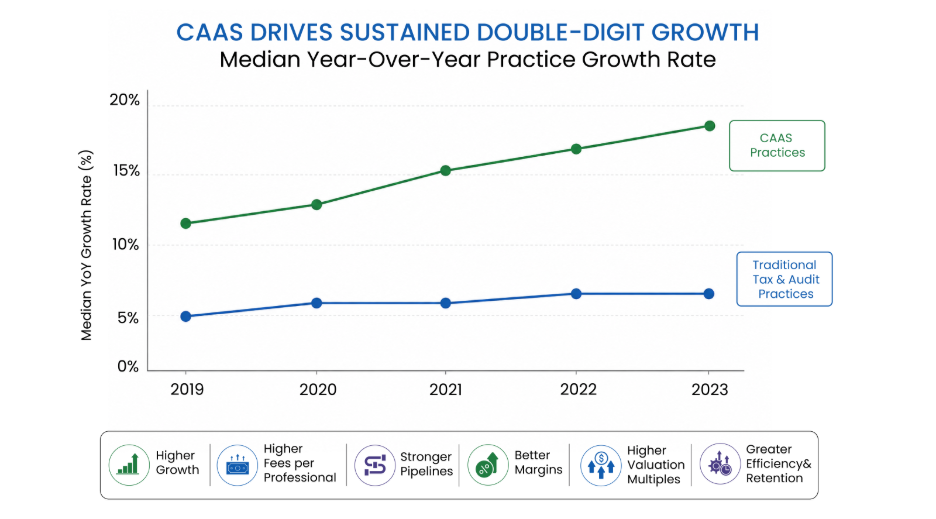
For accounting firms moving into CAAS, there is every reason to expect stable and double-digit revenue growth. It should be noted that while margin return is the single factor often discussed regarding CAAS, the most widely used performance indicator for CAAS is practice growth. This growth is measured from year to year on a median basis at 12% to 17%. While accurate in its calculation, CPA firm owners understand that ROI isn’t a single-form, blanket metric that captures the entire financial valuation in a firm’s financial ecosystem.
ROI is an interconnected system of predictable recurring revenue, higher realization rates, and long-term practice valuation that compounds over time. To gain a comprehensive understanding of the positive impacts of advisory services, the following section highlights specific ROI metrics from the AICPA Benchmark Survey. It also discusses other benefits that an advisory team provides to a firm’s internal workflow and client retention.
Consistent Growth Rates
Surveyed CAAS practices have reported median year-over-year revenue growth rates as high as 17%. This rate routinely outpaces the overall growth of traditional tax and audit practices across the profession, which typically see high single-digit growth. The compounding effect of this consistent growth creates a steady and resilient top line.
High Net Client Fees per Professional (NCFPP)
Mature CAAS practices see significant improvements in professional yield, with median NCFPP regularly exceeding $150,000, and top-performing firms often reaching over $230,000. This high productivity is driven by cloud-based automation and the ability to leverage staff at different tiers to deliver complex, high-margin client deliverables.
Optimistic Pipelines
Firms operating in the advisory space routinely report robust future pipelines. Historically, benchmark data has shown that participating firms project a median 99% growth trajectory for CAS-related revenue over three-year periods. This outlook is anchored by the growing reliance of small and medium businesses on accountants for continuous strategic guidance
Margin Expansion
Transitioning from traditional, regulatory compliance accounting to a high-margin advisory function allows organizations to separate revenue creation from actual time input. By moving away from hourly billing towards value-based or subscription-based pricing, advisory groups will be able to capture premium pricing. This shift will also enable them to realize greater margins.
Valuation Multiples
CAAS practices enjoy significantly higher valuations and EBITDA multiples when going through mergers or acquisitions. The reason is simple since CAAS provides recurring revenue versus transactive or seasonal revenue streams.
Workflow Automation and Efficiency
The implementation of AI, along with cloud-based technologies, ensures automation of mundane and low-value tasks such as data entry and accounting reconciliation. As a result of eliminating these tedious activities, the advisory team is capable of growing its revenues in a manner independent of the need for equal headcount growth. It enables a lean and expert staff to manage a greater number of advisory clients.
Client Retention
Firms that pivot to forward-looking advisory services experience deeper client “stickiness”. Instead of interacting with clients just once a year for tax preparation, CAAS models establish continuous advisory relationships. These involve real-time financial tracking and predictive scenario modeling. Because clients view their accountants as strategic partners rather than overhead costs, this drastically cuts client turnover compared to firms relying entirely on traditional compliance work.
How Advisory Generates ROI
Advisory services tend to lead to higher rates of revenue generation than traditional CPA practices. US accounting firms can realistically expect a 30% to 50% increase in monthly client revenue and a 25% or higher overall revenue boost within their first 12 months of launching advisory services. Advisory generates this ROI by shifting firms from time-based, low-margin compliance to recurring, high-margin, value-based pricing. The section below lists the features that explain a certain inherent advisory model, and how the revenue-generating of advisory services works in practice:
Premium Value Pricing
Advisory firms are transforming their fee structures by shifting away from traditional time-based billing methods and adopting a more modern, value-based model. Instead of charging clients solely for the hours spent on their projects, these firms now base their fees on the actual, tangible results they help clients achieve. This includes the strategic guidance provided, the specific business outcomes reached, and the overall financial improvements realized. By making this change, the connection between the advisory’s revenue and the advisor’s availability or calendar is eliminated.
This approach ensures that the value of the advisor’s expertise is accurately reflected in the pricing. It also aligns more closely with the genuine financial growth delivered to the clients, fostering a more results-oriented and mutually beneficial relationship.
Increased Recurring Revenue
Instead of relying on season-based projects like filing taxes every year, advisory services include regular income generated from retainers made at fixed time periods, such as monthly or quarterly retainers. In this way, the firm will benefit from a guaranteed stream of money, which will minimize the risk of fluctuations in finances. Moreover, the relationship of trust and cooperation is encouraged by maintaining consistent income streams as well. In this way, the firm will create a sustainable and high-value asset for itself, which will not be affected by seasonal fluctuations.
Optional Scale
The Advisory approach allows firms to generate additional income from multiple sources without necessarily increasing their staffing requirements. Through the adoption of advanced technologies and automation techniques, firms are able to offer various high-impact and strategic services that are standardized and scalable. They achieve this by implementing proper delegation techniques. Through this unique way of doing business, the partners and employees are able to concentrate on delivering advisory-based solutions to selected clients that generate a lot of profit.
Key Takeaways
As mentioned in the above blog, there is a striking change in the environment within which CPA firms’ function. This is evident in recent trends in client accounting and advisory services highlighted in the blog. It should be emphasized that the firms adopting these services are enjoying the increased return on investments. It is explained by the changing requirements of the clients who now require something more than the traditional accounting services. They want to see their advisers in the firm.
These advisers not only offer accounting services but also provide insights, assist with financial decisions, and enhance the business’s effectiveness. Thus, CPA firms providing additional services increase their profits by expanding their offerings and attracting more satisfied clients.
In addition, the emerging tendency of making decisions based on data has changed the place of CPA firms in the business environment. Clients want to take advantage of the technology offered and analytics. Thus, becoming advisors rather than service providers is the key to success for the firms.